| |
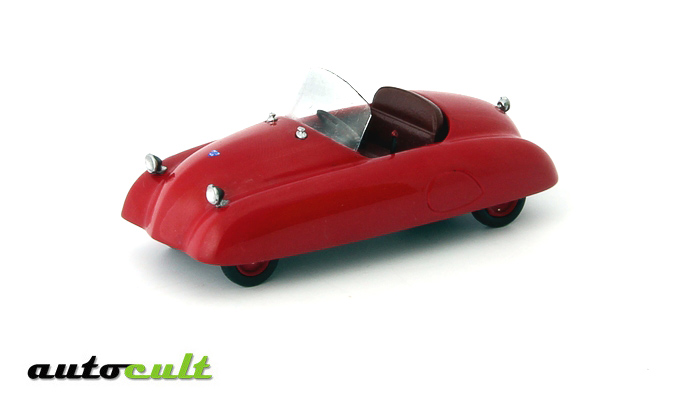
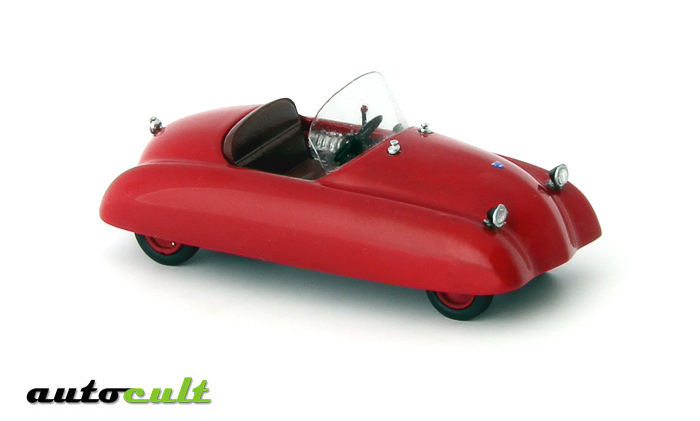
 Volugrafo Bimbo ( 1946 )
Der
Vierrad-Winzling
Dass
Italiener einen Hang zu sehr kleinen Autos haben und hatten, ist
kein Geheimnis. Viele Beispiele in der Geschichte zeigten dies.
In
der unmittelbaren Nachkriegszeit entstand auch das als Volugrafo
Bimbo bekannt gewordene Fahrzeug. Mit den Eckdaten von nur 2,4
Metern Länge, einer Spurweite von knapp über 80 Zentimetern
und einer Höhe von lediglich 90 Zentimetern geriet der Wagen
außergewöhnlich klein. Mit einem Gewicht von 125 kg
wog er zudem sehr wenig. Seine vier Räder der Größe
3,5 x 8 Zoll stammten aus Schubkarren.
Trotz
der Winzigkeit des Kleinwagens konnten zwei Personen im Inneren
Platz nehmen. Diese mussten sich, wegen fehlender Türen,
jedoch schon ziemlich in die kleine Öffnung der rot lackierten
Karosserie zwängen. Saßen sie dann auf der dünn
gepolsterten Sitzbank gab es noch das Problem, dass das Lenkrad
mittig angebracht war, was die Sitzhaltung weiter erschwerte und
der Schalthebel an der linken Seite musste auch noch bedient werden.
Aber ohnehin war eine längere Fahrt zu zweit nicht vorgesehen,
denn der Bimbo hatte nicht einmal einen Kofferraum und im Wageninneren
war auch kein Platz für Reiseutensilien. Mit einer Geschwindigkeit
von 60 km/h war der Volugrafo Bimbo ausreichend für den italienischen
Stadtverkehr motorisiert. Als Antrieb diente ein 125 cm³
großer ohv-Viertaktmotor, der eine Leistung von 4,5 PS entwickelte
und luftgekühlt war. Der Antrieb war unmittelbar am linken
Hinterrad montiert und leitete seine Kraft per Kette über
ein 3-Gang Getriebe auch an das linke Hinterrad weiter. Die Idee
des sehr kleinen Wagens kam aber überhaupt nicht bei der
italienischen Bevölkerung an, denn es gab es so gut wie keine
Käufer. Auch wenn das Mini-Auto schon im November 1945 der
Öffentlichkeit präsentiert worden war – man bedenke,
dass erst im Mai 1945 der Frieden nach Europa zurückkehrte
– , hatten die Leute zu dieser Zeit weitaus größere
Sorgen ihren Alltag zu meistern, als an ein spaßiges Kleinauto
zu denken. Ab Frühjahr 1946 begann die Fertigung in den Werkshallen
der Firma Officine Meccaniche Volugrafo. Dieses Unternehmen war
in Turin ansässig und hatte die Kriegsproduktion von Flugzeugteilen
wieder auf ihre zivile Herstellung von Anhängern und Pumpen
umgestellt.
Die
Produktion des Bimbo wurde zwar bis 1948 aufrechterhalten, dennoch
blieb es bei insgesamt nur 60 ausgelieferten Exemplaren.
 Volugrafo Bimbo ( 1946 )
The
Little Four Wheeler
It is not a secret that Italians have and had a tendency to love
very small cars. A lot of examples in the history were showing
this.
In the immediate post-war-period the publicly known vehicle Volugrafo
Bimbo was created. The car was exceptionally too small with its
basic information of a length of only 2,4 meters, a track width
of nearly over 80 centimeters, and a height of only 90 centimeters.
Moreover, with a weight of 125 kilograms it also weighted very
little. Its four wheels, in the size 3,5 x 8 inch, were made from
a wheelbarrow’s wheels!
Despite of the small size of the small car, two persons could
take a seat inside. Because of missing doors, they must squeeze
themselves into the already quite small opening of the red colored
car body. But there was another problem while sitting on the thinly
padded seat, as the steering wheel was centrically installed and
made a right sitting position difficult and the gear lever on
the left side also had to be operated. A longer journey for two
was not planned, as the Bimbo had not even a trunk and inside
of the car was no space for travel accessories.
The
Volugrafo Bimbo was sufficiently powered for the Italian city
traffic with a speed of 60 km/h. An OHV-four-stroke engine, sized
at 125 cm³, was used for the drive, had a performance of
4,5 hp and was air-cooled. The drive was installed immediately
on the left rear wheel and was forwarding its power by a chain
over a 3-speed transmission to the left rear wheel. The idea of
the small car was not well received by the Italian population,
as there were almost no buyers. Even if the small car was already
presented to the public in November 1945 – bearing in mind
that as late as May 1945 peace returned to Europe – the
people had much greater problems to master their everyday life
as to think about purchasing a funny small car. From spring 1946
the production was starting in the factory halls of the company
Officine Meccaniche Volugrafo. This company was located in Turin
and was converting their war production of aircrafts parts to
civil production of trailers and pumps.
The production of the Bimbo was maintained until 1948, however
only 60 copies were delivered in total.
|
|
 |
 Volugrafo Bimbo ( 1946 )
La
Piccola Quattoruote
Non è un segreto che gli Italiani hanno una tendenza per
le piccole automobli, vi sono Numerosi esempi durante il corso
della storia.
Dopo la fine della seconda guerra mondiale la piccola Volugrafo
Bimbo fu realizzata. l'auto era veramente minuscola, le prime
informazioni parlano di una larghezza di soli 2,4 metri e un'
altezza di soli 90 centimetri. Inoltre, con un peso di soli 125
chilogrammi era molto leggera in termini di peso.
Nonostante le dimensioni minuscole della microcar, c'era spazio
per due persone che potevano sedersi nei due posti a disposizione.
Per via delle portiere non presenti, dovevano stringersi dentro
la già minuscola apertura frontale della piccola Vettura
Rossa. Però c'era un altro problema mentre si ci sedeva
sui minuscoli sedili, dato che il volante era centralmente installato,
questa cosa rendeva difficile avere un posto comodo e la leva
del cambio sulla parte sinistra era assai complicata. Per un lungo
viaggio in due la Volugrafo non era adatta, dato che la piccola
Bimbo non aveva neppure un bagagliaio e dentro l'auto non c'era
spazio per l'occorrente. la Volugrafo Bimbo era sufficientemente
potente per il traffico cittadino Italiano con una velocità
di 60 km/h. Un motore OHV a quattro tempi , con 125 cm³,
era utlizzato per la manovra, aveva una performance di 4,5 hp
ed era raffreddato ad aria. Il motore era installato sulla ruota
sinistra ed la sua potenza era controllata da una catena su una
trasmissione sulla parte posteriore delle ruote. L'idea della
piccola vettura fu non molto apprezzata dalla Popolazione Italiana,
dato che non c'erano nemmeno dei clienti interessati all'acquisto.
Anche se la piccola vettura era già stata presentata al
pubblico nel Novembre del 1945 – tenendo in mente che solo
nel Maggio del 1945 la pace era tornata in Europa – la Gente
aveva molti più grandi problemi per gestire la vita di
tutti i giorni invece di pensare di comprare una piccola e buffa
vettura. Dalla primavera del 1946 la produzione era iniziata nelle
sale della fabbrica gestita dalla compagnia Officine Meccaniche
Volugrafo. Questa azienda era focalizzata a Torino ed aveva smesso
le sue produzioni aeronautiche belliche per continuare come produttrice
di Carri e Pompe per la popolazione civile.
La produzione della Bimbo fu mantenuta fino al 1948, tuttavia
solo 60 esemplari erano stati prodotti in totale.
|
|